

Single-family home
The default case: one owner, one roof, one meter. Most of the standard advice is written for this house.
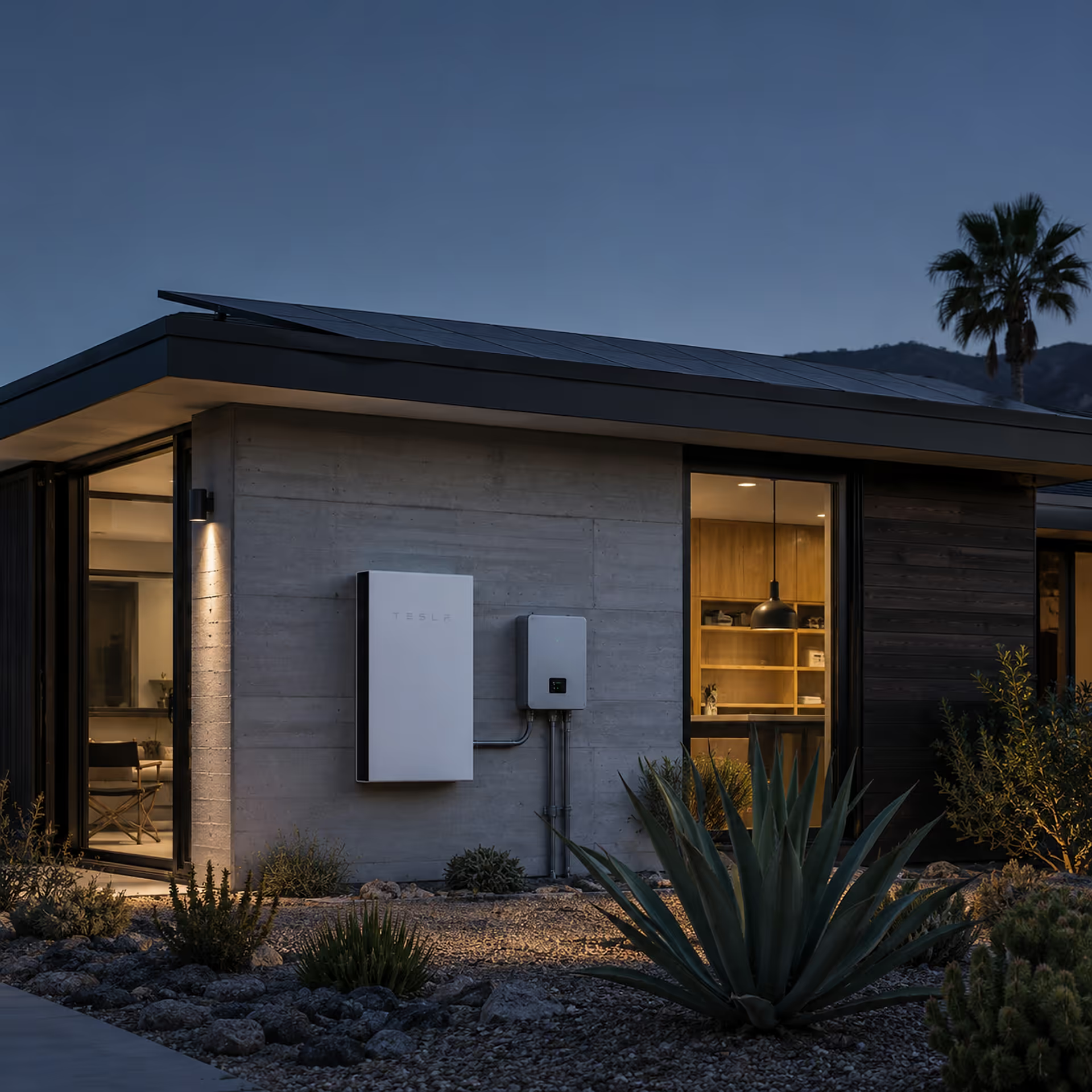
Solar made simple
Solar can affect your electricity bill, your home, your financing and your long-term energy costs. HyreSolar helps you understand the numbers, incentives, equipment, installation process and installer-selection process before you make a decision.
Six questions cover most of why people land here. Pick the one that sounds like you.
Whether the numbers work on your roof, your bill and your utility rules — and the factors that decide it.
What actually moves the price, how to read a quote, and calculators that show their formula.
Federal, state, utility and local programmes stack differently, and not all of them apply to you.
What storage does, what it does not do, and the conditions under which it makes financial sense.
The full sequence from site assessment to permission to operate, and where projects usually stall.
What to verify before you sign, and how to explore options when you are ready.
The decision
Six stages, in the order that saves the most wasted effort. You can stop at any of them.
How solar works and what a system is made of.
Your usage first, then cost, production and payback.
Which incentives apply, and what your utility pays for exports.
Equipment, financing and installation approach.
Licence, insurance, who does the work, what the warranty covers.
Only when you want to. Your call whether, and when.
The library
Twelve entry points into 115 pages. Each one opens onto the guides, studies and calculators for that subject.

None of these are disqualifying on their own. They are the questions a good installer will ask you first.
Get Solar OptionsBefore you go solar
Solar is a twenty-five year decision about a specific roof, a specific electricity bill and a specific set of utility rules. The same system can be an easy call on one house and a poor one two streets away. These are the factors that actually move the answer.
The basics
Four steps, and only one of them involves the panels. The full explainer covers what happens to the surplus, why a grid-tied system shuts down in an outage, and what a system is made of.
Photons strike the silicon cells in each module and knock electrons loose, producing direct current whenever there is usable light.
Your house runs on alternating current. An inverter — one central unit, or small ones under each panel — makes the conversion and manages the array.
Production feeds whatever is running at that moment. Anything the house does not use in real time flows onward.
Extra power charges a battery if you have one, or goes to the grid for a credit set by your utility’s tariff. Which of those is worth more is a local question.
Solar installation services
Six things, and homeowners are usually only shown one of them. Local solar installation companies quote these as a system, not as a panel count.

The modules themselves. Rated in watts, warranted for output over roughly 25 years, and the part of the system least likely to need attention.

Converts DC to household AC. Usually the first component to be replaced — inverter warranties are commonly far shorter than module warranties, so ask for both.

Holds production for later. Whether it pays for itself depends on your export rate, time-of-use pricing and how much you value backup power.
Shows production against expectation. It is how you find out a string has dropped offline, which otherwise goes unnoticed for months.

Rails, flashings and attachments. This is where roof penetrations are made, so it is where workmanship shows up years later as a leak or not.

The meter, the AC disconnect and the interconnection agreement. The utility sets the terms and the timeline for permission to operate.
Money
There is no national price for a home solar system, and any site that gives you one has picked an average and dropped the context. What there is, is a short list of things that set your number.
Programmes
Incentives are the single most volatile input in a solar quote, and the part most likely to be described inaccurately by whoever is selling you a system. They come from four different places and each has its own rules.

Set by tax law and can change with legislation. Eligibility usually turns on when the system was placed in service, not when it was ordered or paid for.
Tax credits, rebates, performance payments and sales or property tax exemptions. Some are funded in rounds and close when the money runs out.
Rebates and storage programmes offered by your specific utility — the neighbouring service territory may have nothing comparable.
City or county programmes, expedited permitting, and occasionally a property tax treatment that only applies inside a jurisdiction.
The federal Residential Clean Energy Credit (Internal Revenue Code §25D) — the 30% credit most solar content still describes as current — is not available for property placed in service after December 31, 2025, following Public Law 119-21. A great deal of published solar advice predates that change and still assumes the credit applies. Confirm the current federal position with the IRS before treating any federal credit as part of your numbers, and note that systems owned by a third party under a lease or power purchase agreement are treated under different provisions than systems you buy.
IRS — Residential Clean Energy Credit · Checked August 11, 2026
What your utility credits you for exported power often changes the economics more than any rebate. Full retail net metering, a lower avoided-cost export rate, and a time-varying export credit produce very different results from identical hardware. This is set by your state commission and your utility, and it is worth confirming before you size a system.
Explore Solar IncentivesSolar + storage
Solar produces when the sun is up. A battery moves some of that production to a time when it is worth more to you — that is the whole idea, and everything else follows from it.
A battery can keep selected circuits running through an outage. Which circuits is a design decision made before installation, and most systems do not back up the whole house.
Where evening electricity costs more than midday electricity, storing cheap production for the expensive window has a measurable value.
When a utility pays little for exported power, using your own production later is worth more than selling it now. This is the main reason storage attach rates rise.
For homes with a well pump, medical equipment or long outages, the value is not financial and does not need to pencil out as payback.
A battery is not required for solar, does not by itself take you off the grid, and cannot be assumed to pay for itself. Whether it makes sense is a function of your rate structure and your tolerance for outages.
Explore Battery Storage

Choosing a professional
The hardware in most residential quotes is more similar than the sales process suggests. What differs is who mounts it, who pulls the permit, and whether a local solar company is still answering the phone in year seven.
HyreSolar does not yet publish installer profiles or ratings, and we are not going to invent them to fill a page. We are building a homeowner-focused framework for evaluating solar professionals — starting with what can be verified from primary sources rather than from marketing.
Marked items reflect what our research process covers today. We will not describe an installer as verified on the strength of a marketplace listing.
Get Solar OptionsExample comparison
This is an illustration of the comparison we are building, using placeholder companies. No real installer is named, rated or ranked below — these rows exist to show which fields matter when three quotes land on your kitchen table.
| Criterion | Installer A | Installer B | Installer C |
|---|---|---|---|
| Years in business | 12 years | 4 years | 20 years |
| Licence | State electrical + solar | State electrical | State electrical + solar |
| Equipment offered | Two module tiers | Single package | Three module tiers |
| Inverter type | Microinverters | String + optimisers | Homeowner’s choice |
| Workmanship cover | 10 years | 5 years | 25 years |
| Financing | Cash, loan | Loan, lease, PPA | Cash, loan |
| Service area | 3 counties | Statewide | 1 metro |
Example only. Placeholder data for layout purposes — not a rating, ranking or recommendation of any company.
By property
The same questions, weighted differently.
The default case: one owner, one roof, one meter. Most of the standard advice is written for this house.

Bigger loads and often a bigger roof, but also more roof planes, more shading geometry and a likelier main panel upgrade.

Tile, slate and metal each need different flashing and mounting hardware, and the labour cost reflects that.

The cheapest time to run conduit and size the electrical service is before the drywall goes up.

Backup changes the design: what stays on during an outage has to be decided and wired for, not chosen later.
Shared walls, smaller roof areas and an HOA or association process that can matter more than the engineering.
Local solar companies
Two identical systems, one in Phoenix and one in Boston, produce different amounts of power, earn different credits for exporting it, offset different electricity rates and qualify for different programmes. Local solar companies already price against those rules; a national average cannot.
Every state is a different question
Hover or tap a state. Highlighted squares are where our first state guides are being written.
Stylised tile map — each square is a state, not a land area. Short notes on structure, not offers or amounts. Programme terms change; confirm current rules for your utility with DSIRE and your utility’s own tariff before relying on any of it.
What we do
Five things, and the fifth is optional. Most people who use this site never reach it.
Guides on how solar works, what it costs, which incentives exist and what each kind of solar work involves. Nothing gated, nothing behind an email address.
Free calculators for savings, payback, system size, battery sizing and loan terms. Every one publishes its formula and its assumptions on the page.
Loan against lease, roof against ground mount, battery against generator. We set out what each option suits rather than naming a winner.
What to check about a solar company before you sign — licence, insurance, who is actually on the roof, and what each warranty really covers.
When you are ready, we can help connect you with solar professionals serving your area. HyreSolar does not install or finance solar systems.
The library
The page you are on is the overview. Underneath it sits the work it rests on: original analysis of federal filings, the statistics that analysis is drawn from, the guides that answer one question properly, and calculators that show their arithmetic.
Analysis computed from federal utility filings, 2014 to 2024. Findings that exist nowhere else.
US residential solar counted from Form EIA-861: adoption, batteries, bills, outages, metering.
Hiring, contracts, equipment and the rules. Every figure carries a primary source and a date.
Every tool publishes its formula and shows the result without an email wall.
Nothing in the library is gated, and no page asks for an email address before it answers you.
Questions
12 of the questions homeowners actually ask. Every answer here is the one we would give a friend, which sometimes means the answer is “it depends, and here is what it depends on.”
All 36 questionsA standard grid-tied system shuts down in an outage. That is a safety requirement, not a fault — it stops your array energising lines that utility crews may be working on. Keeping power during an outage needs a battery and an inverter configured for it, and even then it powers a defined set of circuits rather than the whole house.
Your workmanship warranty is only as good as the company behind it, so that cover may effectively disappear. Product warranties on the panels and inverter are held by the manufacturers and usually survive, though you may have to arrange and pay for the labour to fit a replacement part. Independent solar service companies will work on systems they did not install.
Modules on your roof convert sunlight into direct current. An inverter converts that to the alternating current your house uses. Your home consumes what it can in real time, and anything left over charges a battery or goes to the grid for a credit set by your utility. The panels are the visible part; the inverter and the interconnection agreement are what determine how the system behaves day to day.
There is no single national answer, and a figure quoted without your roof, your usage and your utility attached is not information you can act on. Price is driven by system size, local labour and permitting costs, equipment tier, roof complexity, any electrical upgrades, and whether storage is included. For real installed-price data rather than an estimate, Lawrence Berkeley National Laboratory’s Tracking the Sun and NREL’s cost benchmark are the two public datasets worth reading.
Modules are typically warranted to still produce a specified percentage of their rated output at 25 years, and they usually keep producing after that at a gradually declining rate. The inverter is the component most likely to need replacing first, since inverter warranties are commonly much shorter than module warranties. Ask for both warranty terms in writing — they are separate documents and separate lengths.
Yes, at reduced output. Panels respond to available light, so an overcast day produces a fraction of a clear day rather than nothing. What matters for the economics is not any single day but the annual total, which is why production estimates are modelled over a year using local weather data.
No. A grid-connected system works without one. A battery becomes worth considering when your utility pays little for exported power, when evening electricity is priced higher than midday electricity, or when you want specific circuits to stay live during an outage. It is a separate purchase with its own economics, and it should be evaluated on its own terms rather than bundled into the solar decision by default.
The physical installation on a typical home is measured in days. The overall timeline is usually measured in weeks to months, and it is dominated by design, permitting, inspection and the utility’s permission to operate — none of which the crew on your roof controls. An installer with recent experience in your jurisdiction is the single biggest lever on that timeline.
Get at least three written proposals built on the same assumptions, then compare the documents rather than the presentations. Check licensing for solar work in your state, workmanship coverage separately from equipment warranties, the specific module and inverter models quoted, the production estimate and how it was produced, and the financing terms behind the headline price. Local permitting experience and a service presence near you matter more in year seven than the sales pitch does in week one.
That depends on your state, your utility and sometimes your city, and it changes. The most reliable public index is DSIRE, maintained by the NC Clean Energy Technology Center, which tracks federal, state, utility and local programmes. Your utility’s own tariff documents are the authority on export compensation. We do not list current incentive amounts here because they go stale faster than a page can honestly carry them.
You can, but the sequence matters. An array is designed to sit on the roof for decades, so re-roofing later means paying to remove and reinstall it. If the roof covering is near the end of its life, replacing it first is usually cheaper than doing it twice. A competent installer will raise this before quoting; if nobody asks about the age of your roof, that tells you something.
It is worth it when the net cost, after anything you genuinely qualify for, is recovered by the bill savings within a period you are comfortable with — and when you expect to be in the house long enough to see it. The inputs that decide this are your annual usage, your electricity rate, your roof, your utility’s export rules and the price you are quoted. Anyone who answers this question without those five things is guessing.
Our approach
HyreSolar is an independent resource for homeowners. We focus on helping people understand the decisions involved in going solar — system design, costs, incentives, storage and installer selection — and on connecting them with local solar installers when they are ready to get quotes.
Cost, incentive and technical claims are sourced to government agencies, national laboratories and utility tariffs, and the references are published on the page rather than kept behind the scenes.
Anything time-sensitive carries the date it was checked. Solar policy changes, and undated advice quietly becomes wrong.
Where we do not have verified data yet, the page says so. That is why there are no installer listings on this site today.
HyreSolar expects to earn revenue by connecting homeowners with solar professionals. That relationship will be disclosed, and it will not decide what the guidance says.
Every factual claim above traces to one of these. Content reviewed . How we source and correct that work is in the editorial policy.
When you are ready
If you have done your research and want to speak with a solar professional, HyreSolar can help you explore available options.
Straight answer about what happens next: you tell us about the property and what you want to achieve, and we look for solar professionals covering your area and that kind of work. We cannot promise you will be contacted, how quickly, or what anyone will quote — that depends on your market. Nothing is shared with anyone until you agree on the final step.
HyreSolar is an independent solar information and homeowner-connection platform. We do not install, finance, maintain or service solar systems.
